

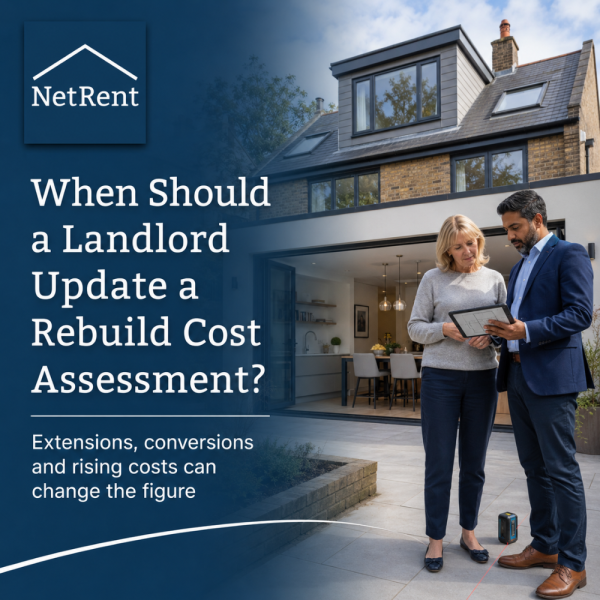
A rental property may rise or fall in market value without materially changing what it would cost to rebuild. Equally, its rebuilding cost can increase even when its sale price remains relatively stable.
That is why buildings insurance should not normally be based on the property’s market value, purchase price or mortgage balance. It should reflect the cost of reinstating the insured building following severe damage, subject to the basis used by the policy.
A rebuild cost assessment is therefore not something to obtain once and forget. It should be reviewed regularly and reconsidered whenever the property or the cost of reconstructing it changes significantly.
What is a rebuild cost assessment?
A rebuild cost assessment—also called a reinstatement cost assessment—estimates the amount required to reconstruct a building following a total or substantial loss.
It may need to account for more than bricks, timber and labour. Depending on the property and policy, the assessment can include:
- Demolition and site clearance
- Removal of debris
- The cost of rebuilding the structure
- Professional fees for surveyors, architects and engineers
- Planning and Building Regulations requirements
- Drainage, utilities and external works
- Outbuildings and boundary structures
- Temporary support and party-wall work
- Restrictions affecting access to the site
- Specialist materials and construction methods
The result is not a valuation of what the property would sell for. A modestly priced property in a difficult location could be expensive to rebuild, while a highly desirable property may have a market value far above its reconstruction cost.
How often should it be reviewed?
RICS professional guidance recommends regular reassessment, an annual adjustment for inflation and a major review every three years—or earlier when significant alterations are made.
That provides a useful starting point, but it should not become a reason to wait. A landlord who materially changes a property may need to review the rebuilding value immediately, even if the last assessment was completed only months earlier.
The appropriate timing depends on the building, the work undertaken and the basis on which the policy is written.
After an extension
An extension can change the rebuilding cost substantially.
This includes:
- A rear or side extension
- An additional storey
- A loft conversion
- A conservatory or garden room
- A garage conversion
- A new outbuilding
- An enlarged kitchen or living area
The additional floor area is only part of the calculation. The work may also introduce new foundations, roofing, glazing, heating, plumbing and electrical installations. Changes to access, drainage and the relationship with neighbouring structures may affect the cost of rebuilding.
The insurer or broker should be contacted before work begins. Ordinary landlord buildings insurance may not provide the required protection while substantial construction work is underway, and specialist renovation or contract-works cover may be needed.
Once the project is complete, the property description and rebuilding figure should be updated without waiting for the next annual renewal.
After a conversion or change of layout
Conversions can alter both the insurance risk and the reinstatement cost.
Examples include:
- Converting a family house into an HMO
- Dividing a building into self-contained flats
- Combining two units
- Adding bedrooms or bathrooms
- Creating a basement room
- Changing residential space to mixed residential and commercial use
- Returning a converted property to a single dwelling
Additional kitchens, bathrooms, partition walls, fire doors, alarm systems, protected escape routes and upgraded services all carry a reconstruction cost.
A conversion can also change the type of policy required. Updating the rebuilding value alone is not enough if the insurer still believes the property is occupied as a single household when it is now let room by room.
The building description, occupancy, tenancy arrangements and licensing position should all be reviewed.
After major refurbishment
Not every decoration or repair requires a new professional assessment. Major refurbishment, however, can significantly alter the specification and cost of the building.
Relevant work may include:
- Replacing the roof
- Installing a high-value fitted kitchen
- Refitting several bathrooms
- Rewiring or replacing heating systems
- Adding solar panels, batteries or heat pumps
- Installing lifts or specialist access equipment
- Undertaking structural repairs
- Replacing ordinary finishes with premium materials
- Carrying out extensive fire-safety improvements
The landlord should consider not just how much the refurbishment cost, but what it would cost to reproduce the completed property after a serious insured loss.
Invoices alone may not provide the correct answer. A competitively priced refurbishment undertaken during normal trading conditions is different from emergency reconstruction involving demolition, professional supervision and compliance with requirements applying at the time of rebuilding.
When specialist materials or features are involved
Standard rebuilding calculators may be useful for straightforward houses of conventional construction. They can be less reliable for unusual, historic or complex buildings.
A professional assessment should be considered where the property includes:
- Listed-building features
- Traditional stone, timber or thatch
- Ornamental plasterwork or specialist joinery
- Unusual cladding or roofing
- Non-standard construction
- Basements or retaining structures
- High ceilings or large glazed areas
- Bespoke kitchens, staircases or architectural features
- Restricted or difficult site access
- Mixed residential and commercial accommodation
Listed buildings and properties in conservation areas may require specific materials, traditional techniques and involvement from heritage authorities. These requirements can increase both the cost and duration of reinstatement.
The assessor needs to understand the property that actually exists, not treat it as an average building of a similar size.
Construction inflation can make an old assessment unreliable
Labour, materials, plant, transport and professional fees do not increase at the same rate as house prices or general consumer inflation.
Construction costs can change because of:
- Shortages of skilled labour
- Higher material and energy prices
- Supply-chain disruption
- Changes to building requirements
- Increased professional fees
- Greater demand following widespread storms, flooding or other events
- Longer rebuilding programmes
Many policies apply index-linking to the declared value or sum insured. This can provide useful protection against changes in cost during the policy period, but it does not prove that the original starting figure was correct.
Index-linking also cannot automatically recognise that a landlord has added an extension, converted the loft, installed specialist finishes or changed the building’s use.
An inaccurate figure increased by an index remains an inaccurate starting point.
When the existing assessment is old or unclear
A landlord should consider a fresh assessment where:
- No professional assessment can be located
- The figure was inherited from a previous owner
- The same amount has appeared on schedules for many years
- Nobody can explain how the amount was calculated
- The floor area or property description is wrong
- The assessment excludes parts of the site
- The building has changed substantially
- The existing report contains assumptions that are no longer correct
Purchasing a property is a natural point at which to check the figure. The amount used by the previous owner may have been calculated for a different policy, use or building specification.
Portfolio landlords should review each property individually. Applying one approximate rate across several different buildings may overlook construction, location and access differences.
After purchasing a tenanted property
Buying with a tenant in place does not remove the need to understand the building.
Before or shortly after acquisition, establish:
- The correct floor area
- The construction and age
- Any extensions or conversions
- Whether alterations received appropriate approval
- The current occupation and use
- Which fixtures and external structures must be insured
- Whether the existing rebuilding figure is supported by a report
Insurance should be arranged at the point when responsibility begins under the purchase arrangements. Landlords should not wait until after completion to discover that a reliable rebuilding figure is unavailable.
Following a significant claim
A major fire, escape of water, storm or subsidence claim may reveal that the building is more complicated to repair than expected.
It may identify:
- Previously unknown construction
- Restricted access
- Hazardous materials
- Additional professional work
- Higher regulatory-compliance costs
- Inaccurate measurements
- Fixtures or outbuildings omitted from the assessment
The claim itself does not automatically establish a new total rebuilding cost. However, the information gathered by surveyors, adjusters and contractors may show that a reassessment is necessary before the repaired property is insured for the future.
Flats and blocks need particular care
For a block of flats, the assessment should normally address the whole insured building rather than the sale values of individual units.
The responsible freeholder, management company or RTM company may need to include:
- Every flat
- Communal halls and stairways
- Roofs and external walls
- Lifts and shared plant
- Garages and stores
- External areas and boundary structures
- Leaseholder improvements that the policy or leases require to be insured
Individual leaseholders and landlord owners should check whether improvements inside their flats are included. Separate estimates produced for individual flats should not create gaps or duplication within the block policy.
What can happen if the figure is too low?
If a property is underinsured, the insurer’s response will depend on the policy wording and the circumstances.
Possible consequences may include:
- The claim payment being limited by the sum insured
- A proportional reduction being applied
- The landlord having to fund part of the rebuilding work
- Insufficient funds for professional fees or regulatory requirements
- Delays while the scope and settlement are disputed
Underinsurance can affect a partial claim as well as a total loss where the policy contains an average or proportional-settlement provision.
Landlords should not deliberately choose a lower figure simply to reduce the premium. The saving may be insignificant compared with the uninsured cost following serious damage.
Can the figure also be too high?
Overinsurance does not normally allow a landlord to profit from a claim. Insurance is intended to place the policyholder approximately back in the insured position, subject to the policy terms.
An unnecessarily high declared value may result in a higher premium without producing a larger settlement. This is another reason to use a reasoned assessment rather than adding an arbitrary margin.
The objective is an appropriate, supportable figure—not simply the highest or lowest number available.
Information to give the assessor
An effective assessment may require:
- Accurate plans and floor areas
- Details of extensions and conversions
- Construction information
- Planning and Building Regulations documents
- Information about listed status or conservation restrictions
- Details of specialist finishes and installations
- Lease requirements for fixtures and improvements
- Site-access information
- Outbuilding and boundary details
- Previous assessments and relevant reports
The assessor should understand exactly which buildings, fixtures and external areas need to be included.
Once the report is received, the landlord should pass the relevant figure and information to the broker or insurer. Obtaining an assessment does not update the policy automatically.
A practical review checklist
Consider a new or updated rebuild cost assessment when:
- Three years have passed since the last major review
- The property has been extended
- The loft, garage or basement has been converted
- The number of units, rooms, kitchens or bathrooms has changed
- Major structural or refurbishment work has been completed
- Specialist or premium materials have been introduced
- The property’s use or occupancy has changed
- Construction costs have moved significantly
- The existing figure is unsupported or inherited
- The property is listed, unusual or difficult to access
- A claim has exposed inaccurate assumptions
- A block or portfolio has not been professionally reviewed
Do not wait for a renewal invitation to ask the question. A significant change should be reported when it occurs.
Review the assessment and the insurance together
A rebuilding figure is only one part of arranging appropriate landlord insurance. The insurer also needs accurate information about the building, occupation, tenancy arrangements, claims history and any ongoing work.
NetRent works with Clear Insurance Management and its experienced property-insurance team to help landlords review these details properly.
If your property has changed or your rebuilding figure is old or unsupported, contact us before renewal. We can examine the existing documents and discuss whether an updated professional assessment should be obtained.
Telephone: 01352 721300
Email: insurance@netrent.co.uk
The right rebuilding figure should reflect the property that stands today—not the property it was several years ago.
NetRent does not provide legal advice. This article represents our general understanding of the landlord insurance and rental property market and is provided for information only.