

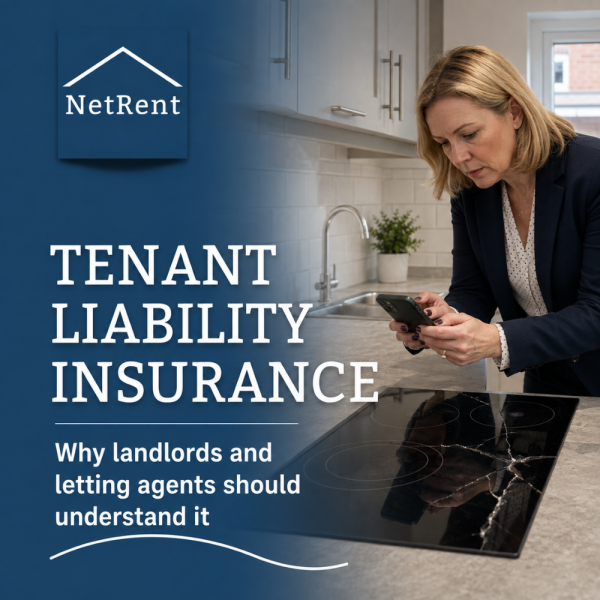
A tenant accidentally drops a heavy pan and cracks the ceramic hob. A bath overflows and damages the landlord’s flooring. A hot object burns a landlord-owned worktop.
Who pays?
The answer may depend on what happened, who is legally responsible, which items were damaged and what insurance protection is in place.
Tenant liability insurance can provide useful protection where a tenant is responsible for accidental damage to a landlord’s fixtures, fittings or contents. However, landlords and letting agents need to understand what it does—and what it does not do.
What is tenant liability insurance?
Tenant liability insurance is generally intended to cover a tenant’s legal liability for specified accidental damage to property belonging to the landlord.
Depending on the individual policy, this might include accidental damage to:
- Furniture supplied by the landlord
- Carpets and flooring
- Kitchen worktops
- Ceramic hobs
- Bathroom fittings
- Doors and internal fixtures
- Other landlord-owned contents
- Certain parts of the rented building
The precise protection varies. A policy may not include every fixture, fitting or item belonging to the landlord, and limits and excesses can apply.
Landlords and agents should check the wording rather than relying on the product name alone.
It is not tenants’ contents insurance
Tenant liability insurance should not be confused with tenants’ contents insurance.
Contents insurance is designed to protect possessions belonging to the tenant, such as clothing, furniture, electronics and other personal belongings.
Tenant liability cover concerns the tenant’s potential responsibility for damage to the landlord’s property.
The two forms of protection serve different purposes. A policy providing tenant liability does not necessarily protect the tenant’s possessions, while ordinary contents insurance may not automatically cover damage to the landlord’s fixtures or furnishings.
It does not replace landlord insurance
Tenant liability protection should complement appropriate landlord insurance rather than replace it.
The landlord may still need to consider:
- Buildings insurance
- Landlord’s contents
- Accidental damage
- Malicious damage by tenants
- Property owners’ liability
- Escape-of-water cover
- Loss of rent
- Alternative accommodation
- Rent and legal protection
- Home emergency assistance
The landlord’s policy may respond to an insured event even when the tenant is not legally responsible. Conversely, tenant liability cover may apply only where the tenant has accidentally caused qualifying damage and is liable for the resulting cost.
The existence of one policy should never be treated as proof that the other is unnecessary.
Accidental damage must be genuinely accidental
Accidental damage is generally associated with an unforeseen and unintentional event, but the individual policy definition is what matters.
Possible examples include:
- A heavy object dropped onto a washbasin
- A landlord-owned carpet damaged by a substantial accidental spillage
- A kitchen worktop burned by a hot pan
- A bath overflowing and damaging flooring
- A landlord-owned item being knocked over and broken
Not every damaged item creates a valid claim.
Policies commonly distinguish accidental damage from:
- Wear and tear
- Gradual deterioration
- Poor housekeeping
- Deliberate or malicious damage
- Defective workmanship
- Maintenance failures
- Damage that existed before the cover began
A worn carpet cannot normally be replaced through insurance merely because the deterioration became apparent during a tenancy.
Malicious damage is different
Malicious damage involves a deliberate act intended to cause harm or damage.
That is fundamentally different from a genuine accident. A tenant who unintentionally cracks a hob presents a different situation from someone deliberately destroying a door or kitchen unit.
Tenant liability insurance should not be assumed to cover malicious damage. The landlord’s own policy may include or offer separate protection, but definitions, limits and conditions will apply.
Landlords should report what actually happened rather than attempting to categorise the incident themselves.
Why should letting agents understand it?
Letting agents are often the first to see the damage, receive the tenant’s explanation and record the circumstances.
A clear process can help establish:
- When the damage occurred
- Who discovered it
- How it happened
- Which items belong to the landlord
- Whether urgent action was required
- What photographs and reports exist
- Which insurance provider should be contacted
Agents should not promise that a claim will be accepted. Their role is to preserve accurate information, notify the landlord and follow the reporting procedure required by the relevant policy.
Where tenant liability protection forms part of an agency service or tenancy arrangement, the agent should understand who holds the policy, who may make a claim and what documentation is required.
Evidence remains essential
A successful outcome may depend on the evidence available.
Landlords and agents should retain:
- A detailed check-in inventory
- Dated photographs
- Signed condition reports
- Inspection records
- The tenant’s account of the incident
- Repair estimates and invoices
- Evidence of an item’s age and original condition
- Communication between the parties
Photographs should be taken before repairs or disposal begin, unless immediate action is necessary to make the property safe or prevent further damage.
The insurer should be contacted promptly and allowed to explain the next steps.
What about the tenancy deposit?
A tenancy deposit is not insurance.
It may provide a route for recovering certain costs at the end of a tenancy, but deductions must be supported by evidence and must account for the age and condition of the damaged item. A landlord should not normally expect a tenant to fund replacing an older item with a completely new one without allowance for wear and useful life.
Deposit-protection rules and tenancy terminology differ across England, Wales, Scotland and Northern Ireland. Landlords and agents must use the procedures applying where the property is situated.
Insurance and deposit recovery may also interact, so the same loss should not be recovered twice.
Questions landlords and agents should ask
Before relying on tenant liability protection, establish:
- Who is insured under the policy?
- Who can report or pursue a claim?
- Which fixtures, fittings and contents are included?
- Does the cover extend to parts of the building?
- What financial limit and excess apply?
- Is malicious damage excluded?
- How is accidental damage defined?
- What evidence is required?
- Does the cover apply throughout the tenancy?
- How does it work alongside landlord insurance and the deposit?
The answers should be confirmed from the current policy documents.
Review the complete insurance position
Tenant liability cover can provide a useful additional layer of protection, but only when everybody understands its purpose and limitations.
NetRent works with Clear Insurance Management and its experienced property-insurance team to help landlords and letting agents examine their insurance requirements properly.
If your landlord insurance is approaching renewal, send us your existing documents so we can review the property information, cover, conditions and premium. We can also discuss tenant liability protection and how it may fit alongside the landlord’s wider insurance arrangements.
Telephone: 01352 721300
Email: insurance@netrent.co.uk
Tenant liability insurance can help protect a landlord’s property, but it should form part of a properly considered insurance package—not become a reason to leave gaps elsewhere.
NetRent does not provide legal advice. This article represents our understanding of rental property law.