

When damage occurs, the first priorities are safety, preventing further loss and notifying the insurer. Afterwards, the available evidence can make a significant difference to how efficiently the claim is assessed.
Photographs, receipts and records can show what happened, what was damaged, who owned an item, its previous condition and the reasonable cost of repair or replacement. They do not guarantee acceptance, but they can help landlords answer an insurer’s questions accurately.
Start before there is a claim
The most useful claims file is created before anything goes wrong. Every property should have the current policy schedule and wording, statement of fact, renewal documents and claims contact details.
Landlords, letting agents and property managers should also retain:
- Tenancy or occupation agreements
- Check-in and check-out inventories
- Dated photographs of rooms, fixtures and landlord-owned contents
- Routine inspection reports
- Gas, electrical and fire-safety records
- Maintenance invoices and contractor reports
- Warranties, manuals and serial numbers
- Records of renovations, extensions or conversions
- Reinstatement-cost assessments where applicable
- Correspondence about defects, repairs or previous incidents
These documents can help distinguish sudden damage from a pre-existing problem and show that the property has been inspected and maintained.
Take useful photographs
A few close-up images may not explain the scale or location of damage. Begin with wide photographs showing the whole area, then take closer views from several angles. Capture adjoining surfaces that may also have been affected.
Inventory and inspection photographs can be particularly valuable because they show the property before the event. Date or link them to a dated report, label the property and room, and retain the original files. Do not edit an image in a way that changes what it shows.
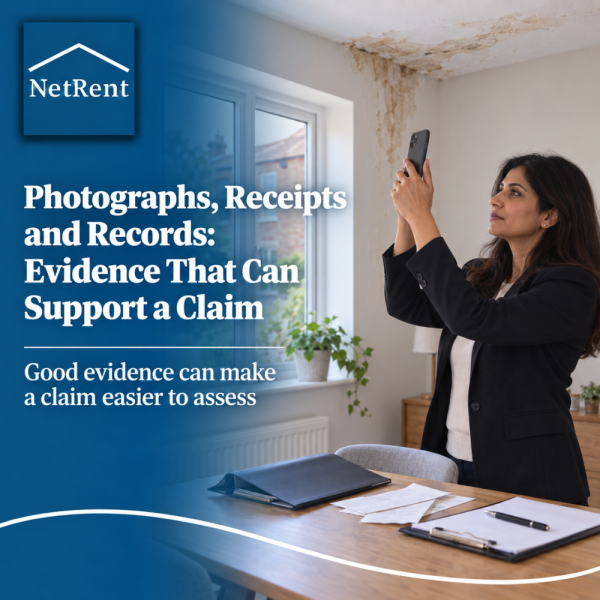
After an incident, photograph or film the damage before cleaning or repairs begin, provided it is safe to do so. Safety must always come first: nobody should enter a dangerous building or delay urgent work simply to obtain photographs.
Keep receipts and proof of ownership
Receipts can help establish when an item was purchased, its specification and original cost. For landlord-owned contents, keep purchase invoices, delivery confirmations, warranties and photographs of the item in the property.
If the original receipt is unavailable, a bank statement, order confirmation, duplicate invoice, serial number or inventory photograph may help. The insurer will decide what is sufficient.
Never create, alter or exaggerate a receipt or record. If evidence is missing, explain that honestly and provide whatever reliable alternatives are available.
Record maintenance and previous condition
Insurance is not a substitute for routine maintenance. A claim may involve both insured damage and an underlying component that has deteriorated through age or wear.
For example, an insurer considering water or storm damage may ask when the roof or plumbing was last inspected and repaired. Maintenance invoices, photographs and contractor reports can help answer those questions.
Record reported defects, the response, the contractor instructed and the completion date. A clear history is more useful than trying to reconstruct events after a loss.
Create an incident timeline
As soon as an incident is discovered, begin a simple written timeline. Record:
- The date and time the problem was found
- Who discovered and reported it
- What the tenant, agent or contractor observed
- Any immediate safety action taken
- When the insurer or claims line was contacted
- The names of contractors who attended
- Temporary work authorised and its purpose
- Advice received and decisions made
- When supporting documents were supplied
Ask tenants and witnesses for a factual account while events are fresh. Avoid coaching their description, guessing at the cause or accepting liability. Retain any emergency-service reference number or report.
Preserve damaged items where possible
Do not dispose of damaged property simply because it appears unusable. The insurer or an appointed loss adjuster may wish to inspect it.
If an item presents a hazard and must be removed, ask the insurer for guidance where possible. Photograph it, record its make and model and note why disposal was necessary.
Emergency work may be needed to prevent further damage. Contact the insurer first where circumstances allow, keep invoices and distinguish temporary protection from permanent repairs.
Prepare a clear claim schedule
For a claim involving several items, create a schedule listing each loss, its location, owner, approximate age, previous condition, original cost, estimated repair or replacement cost and supporting evidence.
Buildings, fixtures, fittings and contents may fall under different sections of a policy. A clear list helps the insurer categorise the damage, although the insurer will make the final decision under the wording.
For loss-of-rent claims, retain the tenancy agreement, rent schedule, payment ledger and evidence of the period the property could not be occupied because of insured damage. Keep invoices for any potentially covered additional costs.
Store records securely
Create a digital folder for each property and use consistent filenames containing the date, room and subject. Back up important records and control access to personal information.
Review the folder at renewal and after inspections or major repairs. Orderly records are easier to use during a stressful claim than documents scattered across devices.
Evidence supports the assessment
The insurer will consider the cause of damage, policy cover, exclusions, conditions, limits and excesses as well as the evidence provided. Good documentation cannot make an uninsured event payable, but it can help demonstrate the facts and the reasonable value of an insured loss.
NetRent works with Clear Insurance Management and its experienced property-insurance team to help landlords review their insurance arrangements. Clear provides claims support for policies arranged through Clear, while the insurer remains responsible for decisions about cover and settlement.
To discuss landlord insurance, telephone 01352 721300 or email insurance@netrent.co.uk.
NetRent does not provide legal advice. This article represents our general understanding of the landlord insurance and rental property market and is provided for information only.