

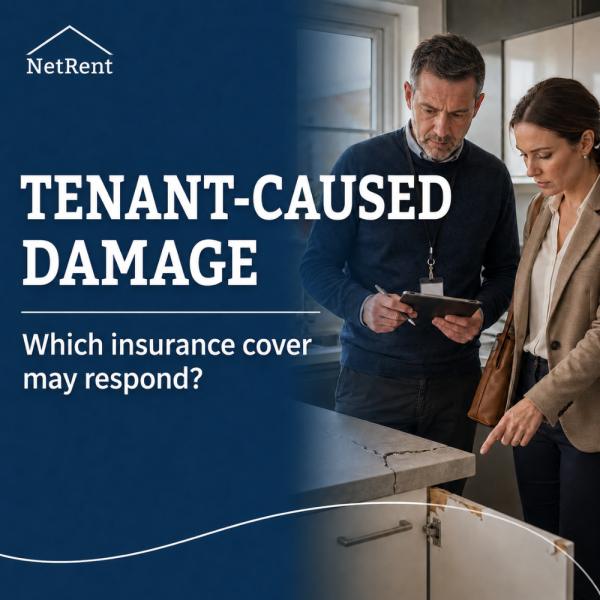
Damage caused by tenants is one of the most misunderstood areas of landlord insurance.
A landlord may discover a cracked worktop, damaged carpet, broken cupboard door or flooded bathroom and assume that the insurance policy will automatically meet the cost. Unfortunately, the fact that damage happened during a tenancy does not, by itself, establish that it is insured.
The cause of the damage, whether it was deliberate, the items affected and the sections of cover selected can all influence whether a claim is accepted.
Was the damage accidental?
Accidental damage is generally understood to mean damage resulting from an unforeseen and unintentional event. However, the precise definition will be found in the individual policy.
Possible examples include:
- A tenant dropping a heavy object and cracking a washbasin
- A television being knocked from a landlord-owned cabinet
- A hot pan accidentally damaging a kitchen worktop
- A bath overflowing and damaging flooring or a ceiling below
- A landlord-owned carpet being damaged by a significant accidental spillage
Accidental damage is not necessarily included automatically in every landlord policy. It may be an optional extension, and the protection applying to the building may differ from that provided for landlord-owned contents.
The landlord should therefore check which sections of the policy include accidental damage, the applicable excess and any exclusions.
Is it malicious damage?
Malicious damage is different from accidental damage because it involves a deliberate act intended to cause damage.
Examples might include doors being intentionally kicked in, fixtures being deliberately destroyed or walls being purposefully damaged. Establishing that damage was malicious can require evidence of what happened and who caused it.
Landlords should not assume that every policy includes malicious damage by tenants. Some policies exclude it, apply a separate limit or only provide protection when particular conditions have been met.
Vandalism by an unknown third party may also be treated differently from deliberate damage caused by a tenant or someone lawfully permitted to enter the property.
Where deliberate damage is suspected, the landlord should contact the insurer or broker promptly and ask what evidence is required. Depending on the circumstances, this may include photographs, inspection reports, correspondence and a police crime reference number.
Could another insured event apply?
Sometimes the relevant question is not simply whether the landlord has accidental-damage protection.
Suppose a tenant accidentally leaves a tap running and water damages the ceiling below. The resulting loss might need to be considered under the policy’s escape-of-water section. If a cooking accident causes a fire, the fire section may be relevant.
That does not mean every resulting cost will be covered. The insurer will examine what happened, which parts of the property were affected and the policy’s definitions, exclusions, conditions and excesses.
Landlords should report what actually occurred rather than trying to decide for themselves which section of the policy should respond.
What is wear and tear?
Wear and tear is the gradual deterioration that results from normal use and ageing. It is generally not something insurance is designed to cover.
Examples may include:
- A carpet becoming worn along a frequently used walkway
- Minor scuffs and marks accumulating on walls
- Hinges or handles becoming loose through ordinary use
- Appliances deteriorating with age
- Faded decoration
- Sealant gradually failing
There can be disagreement about where reasonable use ends and damage begins. A small mark after several years of occupation may be ordinary deterioration, while extensive damage occurring suddenly may have a different cause.
The property’s age, original condition, quality of materials, number of occupants and length of the tenancy can all be relevant.
Insurance should not be regarded as a maintenance contract or a way to replace items that have reached the end of their normal life.
Could tenant liability cover help?
Tenant liability protection may be relevant where a tenant is legally responsible for accidental damage to the landlord’s fixtures, fittings or contents.
This can offer useful protection for the landlord’s property, but it should not be confused with a comprehensive landlord insurance policy. The cover may be limited to specified types of accidental damage and will be subject to definitions, exclusions and financial limits.
It may not cover:
- Ordinary wear and tear
- Deliberate or malicious damage
- Gradual deterioration
- Defective workmanship
- Damage to the tenant’s belongings
- Every cost claimed by the landlord
Landlords and letting agents should understand exactly what the tenant liability arrangement covers and how a claim must be made. It should complement appropriate landlord insurance rather than replace it.
Is the tenancy deposit another form of insurance?
A tenancy deposit is not an insurance policy.
It may provide a route for recovering some costs where the tenant has breached the tenancy agreement, but any deduction should be supported by evidence. The landlord cannot automatically charge the tenant the full cost of replacing an older item with a new one.
Tenancy deposit protection operates through different systems in England, Wales, Scotland and Northern Ireland. The rules, terminology and timescales are not identical, so landlords and letting agents must follow the requirements applying where the property is located.
In every UK nation, good evidence is essential when a deposit deduction is disputed.
Evidence can determine the outcome
Landlords should maintain:
- A detailed check-in inventory
- Clear dated photographs
- Records of inspections
- Check-in and check-out reports
- Receipts or evidence of an item’s age and value
- Repair estimates and invoices
- Relevant communication with the tenant
When damage is discovered, it should be photographed before repairs or disposal begin, unless immediate action is necessary to make the property safe or prevent further loss.
The insurer or broker should be contacted promptly. Landlords should not assume that they can complete all the work and submit the bill afterwards.
Check the cover before damage occurs
The best time to understand tenant-damage protection is before a claim.
At renewal, landlords should ask:
- Does accidental damage apply to both buildings and contents?
- Is malicious damage by tenants included?
- What limits and excesses apply?
- Are there conditions relating to referencing or inspections?
- What evidence would be required?
- Could tenant liability protection provide additional support?
NetRent works with Clear Insurance Management to help landlords understand the protection being proposed rather than relying on assumptions.
If your landlord insurance is approaching renewal, send us your existing documents and let us review the cover, conditions and premium properly.
Telephone: 01352 721300
Email: insurance@netrent.co.uk
NetRent does not provide legal advice. This article represents our understanding of rental property law.