

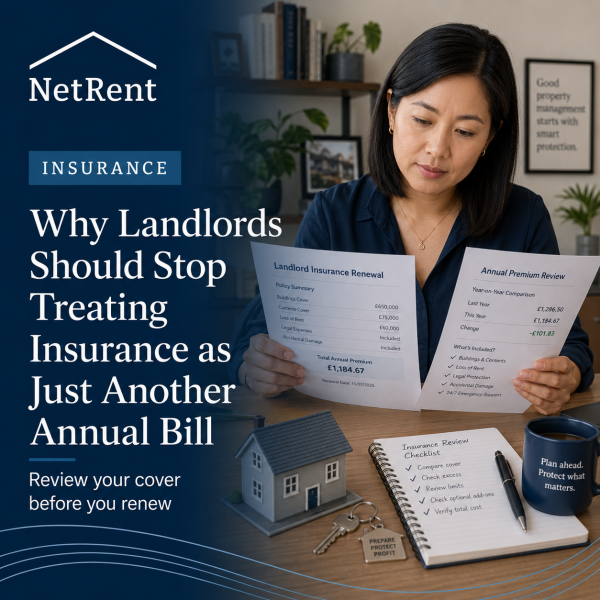
For many landlords, insurance renewal is treated like an annual bill.
It arrives once a year. The premium is checked. If the price has gone up, the landlord may complain. If the increase is not too painful, the renewal may be accepted. If the increase feels excessive, the landlord may ask for an alternative quote or go back to the existing broker and push for a reduction.
That is understandable. Landlords already have plenty to deal with: mortgage costs, repairs, compliance, tenant issues, taxation, regulation and the day-to-day responsibility of owning rental property.
But landlord insurance should not be treated as just another recurring cost.
It is not the same as paying for utilities, software, membership fees or routine admin. It is one of the key protections sitting behind the landlord’s property investment.
And when it is wrong, weak or outdated, the consequences may only become clear when something has already gone wrong.
Insurance is not just a price
Nobody likes paying for insurance. Most landlords would rather the money stayed in their account.
That is why the premium tends to get most of the attention.
But the price is only one part of the decision. The real issue is what the landlord is buying for that premium.
Does the policy properly reflect the property?
Does it reflect the tenant type?
Is the sum insured accurate?
Is loss of rent cover adequate?
Is malicious damage by tenants included on appropriate terms?
Are the excesses reasonable?
Are the unoccupancy conditions clear?
Have all material facts been disclosed?
Would the policy respond as expected if there was a claim?
Those questions matter far more than whether the renewal document looks familiar.
A landlord’s risk changes over time
A rental property does not stand still.
Tenants change. Occupancy changes. Property values change. Rebuild costs change. Regulations change. Mortgage pressures change. Portfolios grow or reduce. Some properties move from one tenant type to another. Some may be empty between tenancies. Some may be refurbished. Some may become HMOs or be let in different ways.
If the insurance is simply renewed each year without proper review, the policy can gradually drift away from the landlord’s real circumstances.
That is one of the dangers of treating insurance as just another bill.
A bill is paid.
Insurance should be checked.
The renewal process should challenge assumptions
A proper landlord insurance review should not start and finish with last year’s policy.
It should challenge whether last year’s arrangements are still right.
That means asking the right questions and not assuming that the existing policy still fits.
For example, a landlord may assume the sum insured is still adequate because it was accepted last year. But rebuild costs may have changed. A landlord may assume tenant-related damage is covered, but the policy wording may be more limited than expected. A landlord may assume loss of rent is sufficient, but the actual level of cover may not reflect current rental income.
These are exactly the kinds of issues that should be considered before renewal.
Not after a claim.
Cheap cover can create false confidence
Landlords are right to want competitive insurance. Paying more than necessary helps nobody.
But cheap cover is only good value if it is suitable.
A lower premium may look attractive, especially at a time when landlords are under financial pressure. But if the lower price is achieved by weaker cover, higher excesses, important exclusions or poor policy fit, it may not be a saving at all.
The problem is that poor cover can look acceptable until it is tested.
That is why landlords should be careful about comparing insurance purely by price. A cheap policy and a suitable policy are not always the same thing.
Your broker should be working for your renewal
If a landlord has stayed with the same broker for years, it is easy to assume that the broker is actively checking the market, reviewing cover and making sure the renewal remains competitive.
Sometimes that may be true.
But landlords should not assume it.
If your broker only becomes competitive after you show them another quote, it is reasonable to ask whether they were properly challenging your renewal before that point.
If your renewal has simply been sent out year after year with limited discussion, limited questioning and limited review, you may not be receiving the level of service your property investment deserves.
A renewal should not be based on inertia.
Portfolio landlords need even more attention
This is especially important for landlords with several properties.
If you own five, ten, fifteen or more rental properties, insurance is not just an annual bill. It is a major part of protecting your portfolio.
A portfolio may include different property types, different values, different tenants, different levels of rent, different risks and different policy requirements.
That should be reviewed properly.
A portfolio landlord should not be left wondering whether the broker has simply rolled everything forward for another year. The cover should be challenged, the market should be considered, and the landlord should understand whether the arrangements remain suitable and competitive.
Why NetRent challenges the renewal process
NetRent has worked with landlords for 23 years. We understand that insurance is not something most landlords enjoy dealing with, but we also understand how important it is when something goes wrong.
Through our partnership with Clear, landlords have access to a dedicated NetRent insurance team with specialist experience in landlord property insurance.
NetRent’s role is to speak to landlords, understand the property or portfolio, ask the right questions and pass properly considered information to Clear’s NetRent team. That helps produce quotes based on the landlord’s actual circumstances, not just assumptions.
This is why we believe landlords should send us their renewal before they commit.
The aim is straightforward: to help landlords challenge their renewal, check whether the cover remains appropriate, and see whether a more competitive or better-suited option is available.
Do not treat protection like paperwork
Insurance is easy to undervalue when nothing has gone wrong.
But when there is a fire, flood, escape of water, major damage, tenant issue, void period or claim dispute, the quality of the policy and the support behind it suddenly matter.
That is why landlord insurance deserves more than a quick glance at the premium.
It deserves review.
It deserves challenge.
It deserves proper questions.
And it deserves to be dealt with before the renewal deadline is too close to make a considered decision.
Contact NetRent before you renew
If your landlord insurance renewal is approaching, do not treat it as just another annual bill.
Send it to NetRent before you commit.
Let us review what you have been offered. Let us ask the right questions. Let us see whether Clear’s dedicated NetRent team can provide a competitive alternative that properly reflects your property or portfolio.
You may save money. You may improve your cover. You may discover that your current arrangements have not been reviewed as carefully as they should have been.
But most importantly, you will not be renewing blind.
Call NetRent: 01352 721300
Email: insurance@netrent.co.uk
Before you pay another landlord insurance renewal, send it to NetRent and let us challenge it properly.